April 17 - May 23
Springs Projects, New York
Avery Z. Nelson
Catalina Schliebener Muñoz
Edie Fake
Ever Baldwin
Fran W.
Judy Giera
KC Crow Maddux
Keltie Ferris
Nic Koller
With a set by DJ Brattyboi, and a performance by Nic Koller
curated by Sarah Davidson and Vic Roth
checklist


photos: Andrew Schwartz
-Gordon Hall (“Why I Don’t Talk About ‘The Body’: A Polemic”, 2020)
No point in making myself comfortable. The abstraction, the dream, are as limited for me as the concrete and the real. What to do? Show a part of it only, in a narrow mirror, as if it were the whole? Mix up a halo with spatters? Refusing to bump into walls, bump into windows instead? In the black of night. Until I see everything clearly, I want to hunt myself down, struggle with myself.
-Claude Cahun (Disavowals, 1930)
While No Point in Making Myself Comfortable encompasses approaches which all relate to “the body”, as curators, we were inspired by artist Gordon Hall's rejection of the term 'the body' as a universal signifier in favour of more specific explorations of embodiment. Claude Cahun's use of her own body as a gender-bending medium in the first half of the XXth century was a spiritual touchstone in juxtaposing these artists, whose varied approaches to figuration via abstract gestures tease the limits of the term “queer abstraction”. Rather than claim to reflect a universal experience of embodiment, the works in this exhibition reflect on idiosyncratic themes – from childhood to desert scarcity – via approaches as varied as biomorphism, self-portraiture, diagrammatic flatness, cartoon figuration, and intuitive dreamscape.
In works by Keltie Ferris, KC Crow Maddux, and Nic Koller, mediated impressions of the artists’ own bodies play a central role. In Ferris’ work, the artist wields his clothed body as a painting tool for its own recording. Indexed onto the surface of the canvas, the body print reveals a ghostly presence that simultaneously emerges and submerges, mediated by paint. In Maddux’s sculptural pieces, the photographic image is fragmented and recombined, suggesting a modular, assembled version of the self. Rigid shapes turn into pointing limbs that refer back to the abjectness of the subject with semiotic wit and humor. Koller’s paintings, based on low-fi multiple exposure photos, both capture and refract the artist in a flash. Scumbled pastel grazes the grain of the canvas in an attempt to describe the body’s apparition, only to let it hover, mannequin-like, in its own glitchy haze.
In Catalina Schliebener Muñoz’s world, bodily abstraction becomes an environment: their room-sized installation occupies the interior chamber of the exhibition like a pulsing lung. Cartoon gestures upend familiar tropes of children’s stories, and the over-layed spilling out of imagery and soft sculpture becomes both funny and discomforting. Judy Giera also plays with ideas of environment: her functional light installation invites a hang-out, presenting the female form as a supplier of endless comfort and energy (she’ll charge your phone!). The monumental, foreboding fixture is both tactile and grotesque, a theatrical wink towards Peewee’s playhouse.
In Fran W.’s cerebral yet dreamy paintings, theatrical object-ness is more metaphysical. W's avatar-like “girl” disrupts self-serious painting styles of the last hundred years, confusing scale relationships to play with the various connotations of “doll”. It’s often unclear if “the girl” is a full-sized human or a toy. In turn, Edie Fake’s disco-inflected paintings diagram the artists’ relationship to the desert environment. In them, desert and body systems conjoin to offer an ecstatic arena where scarcity and queer utopia can coexist – like Downpour Uproar, where landscape and suggestive bodily metaphor intertwine.
Avery Z. Nelson’s paintings are also born of embodied sensation, offering a fluid and color-driven experience where bodily description barely coalesces. Instead, discreet moments reveal themselves quietly, like the sketched outline of a hand tenderly opening a suggestive fold. Ever Baldwin’s intuitive work also reflects their experience of living in a body, but the insect-like, biomorphic paintings take on a mysterious life of their own. With bulbous wooden frames, Baldwin’s paintings question the boundaries of bodily-ness contained within the embedded canvas, suggesting pulsating organisms borne of correlated parts.
-Sarah Davidson and Vic Roth
—
Avery Z. Nelson (they) was born in Rhinebeck, NY and lives and works in NYC. Nelson’s vibrant and sensual paintings record the inner experience of a trans self beyond constructs of gender, remapping the body’s erogenous zones in ever-shifting ways. Grounded in gesture, rhythm, and dance, Nelson generates friction between movement and stillness, figure and landscape, to erupt and destabilize categories within poetic compositions.
Nelson has presented solo shows most recently at Chozick Family Gallery (NYC), Blade Study Gallery (NYC), Rachel Uffner Gallery (NYC), and Prats Nogueras Blanchard (Barcelona). Nelson's work has been included in group exhibitions at many spaces including DS Galerie (Paris), Para Site (Hong Kong) and the DePaul Art Museum (Chicago). Their work has been reviewed in publications such as The Brooklyn Rail, Artforum, Artspace, and Spike Magazine. In 2019 Nelson received a Sharpe Walentas Studio Fellowship, and in 2021 they were a recipient of an FST Studio Funding Grant.
—
Catalina Schliebener Muñoz (they/them) (b. Santiago, Chile, 1980), is a Sudamerican, Chilean-born visual artist and educator living in Brooklyn, who works primarily with collage, installation, and murals. Their work draws on images, objects, and narratives associated with childhood and explores gender, sexuality, and class. They earned a Bachelor of Philosophy (2008) and a Bachelor of Visual Arts (2005) from the Universidad de Arte y Ciencias Sociales (ARCIS; Santiago, Chile).
Schliebener Muñoz’s work has been exhibited internationally including solo shows at Olympia, New York, NYC (2025), Queens Museum, Queens, NYC (2024), Mattress Factory, Pittsburgh, PA (2024), Bureau of General Services—Queer Division, New York, NYC (2022, 2016), Boston Center for the Arts, Boston, MA (2021), HACHE Arte Contemporáneo, Buenos Aires, Argentina (2017), Point of Contact Gallery, Syracuse University, Syracuse, NY (2016), CCMATTA, Buenos Aires, Argentina (2015), Fundación Esteban Lisa, Buenos Aires, Argentina (2014), CCE-Centro Cultural de España, Santiago, Chile (2011), Galería Bech, Santiago, Chile (2006), among others. Schliebener Muñoz is a recipient of the following grants: FONDART Grants – Cultural and Arts Development Fund of the Government of Chile (2006, 2007, 2008, 2009), DIRAC – Board of Cultural Affairs, Ministry of Foreign Relations of Chile (2007), The Foundation for Contemporary Arts, Emergency Grant (2021, 2024) and Foundation for Contemporary Arts, Creative Research Grant (2025) among others. They also received a Queer Artist Fellowship from the Leslie-Lohman Museum of Art (2017), and an Artist in the Marketplace (AIM) Fellowship from the Bronx Museum of the Arts (2018). Schliebener Muñoz was an In Situ Fellow (2022-2024) at Queens Museum, Queens, NY.
—
Plotted out beforehand using graphite pencil, rulers and protractors, and hand-painted with the illusion of hard-edged precision, Edie Fake’s artistic practice mines the grammar of architecture to carve out space for bodies that have been othered and invalidated by dominant systems of knowledge. Fake’s abstract representations of community form and collapse, cohere and dissipate, reflective of the real experience within queer lives and their ever-shifting constellations, while centering his central concern for the audacity of queer utopian imagining.
Since moving from first Chicago, then to Los Angeles while briefly attending grad school at USC, to the high desert of Joshua Tree in California, and currently Vancouver, BC, Fake’s work has evolved from his acclaimed Memory Palaces series — reimagined facades of urban lesbian bars and gay nightclubs — to a new feeling of vulnerability due to shifts in the U.S. social and political climate. The work blurs lines between architecture and body with structures adorned by elements that seem to be both decorative and protective. Architectural components are used as visual metaphors for the ways in which definition and validation elude trans identities. Says Fake, “More and more I’m trying to bring an anarchy into that architecture, or a fantasy and ecstasy of what queer space is and can be.”
Edie Fake’s (b. 1980, Evanston, IL) multi-media work — drawings, paintings, installations, comics, books and zines — has been exhibited in solo shows at the Museum of Contemporary Art, Chicago; Berkeley Art Museum and Film Archive; Everson Museum of Art, Syracuse; and in New York City at The Drawing Center, Broadway Gallery and Marlborough Gallery. His 2018 show at Western Exhibitions was reviewed in Art in America. Fake’s work is held in the collections of the Billy Ireland Cartoon Library & Museum, Columbus; Des Moines Art Center, Iowa; RISD Museum, Providence; KADIST, San Francisco; Nerman Museum of Contemporary Art, Kansas; and the Santa Barbara Museum of Art. He was one of the first recipients of Printed Matter’s Awards for Artists and his Gaylord Phoenix collection of comics won the 2011 Ignatz Award for Outstanding Graphic Novel. His work has been written about and featured in artforum, New York Times, The Paris Review, Art News, Art 21, Juxtapoz, Hyperallergic, The Comics Journal, and The Los Angeles Review of Books. Edie Fake was born in Chicagoland in 1980 and received a BFA from the Rhode Island School of Design in 2002. Fake is represented by Western Exhibitions in Chicago and Broadway Gallery in New York, and he currently lives and works in Vancouver, Canada
—
Ever Baldwin creates abstracted paintings with sculpted, wooden frames that extend the composition from canvas to frame. Baldwin lives and works in Catskill, NY. They hold a BFA in painting from The Maryland Institute College of Art and an MFA from The School of The Museum of Fine Arts in Boston. Recent solo exhibitions include Marinaro, New York; The Ogunquit Museum of American Art, Ogunquit, ME; LeFebvre et Fils, Paris; Emma Gray HQ, Los Angeles, CA; and JAG Projects, Hudson, NY. Their work has been included in groups shows at Vielmetter, Los Angeles, CA; Modern Art, London; and Art Omi, Ghent, NY among others.
—
Franella Marceline W. (b. 1996, Châteauguay, CA) is a painter based in Montréal. In Franella’s work, figures emerge from a world of geometric abstraction, taking the form of ethereal girls and women. Transgender visual puns; eggs, fish, and dolls situate the scene in the middle-space between words and images. Dresses, boots, blouses, skirts, fishnets, graffiti, and urban decay erupt from the surface like a sore: raw queer desire dissolves the ambiguous geometry of colourful interior spaces in a kaleidoscopic cum-stain of lowbrow maximalism. Fran has presented a solo exhibition at Franz Kaka gallery in Toronto, realised a two person exhibition at Espace Maurice in Montréal, and has held a solo exhibition in an off-site context in Montréal curated by Alexa Hawksworth
—
Judy Giera is a Brooklyn, NY-based artist and arts worker. She has presented solo exhibitions with the NARS Foundation, haul gallery, Waterloo Arts Center, and SPANTZO. Her work has appeared in group exhibitions at High Noon Gallery, The Hudson River Museum, The Painting Center, Bronx Arts Space, Trestle Gallery, Gallery Aferro, among others. Judy was a 2022 AIM Fellow with the Bronx Museum of the Arts, and her work was included in Bronx Calling: The Sixth AIM Biennial at the museum in 2024. Giera was awarded the Davyd Whaley Scholarship at the Art Students League of New York and has participated in residency programs with SVA, NYC Crit Club/Plum Line Residency, The Potato Farm Project/EFA North Fork, and ChaShaMa/Cha North. Judy holds an MFA in Art from Lehman College (CUNY) and an MFA in Theatre from Pace University. In addition to her art practice, Judy is the Associate Director of Collections for the Leslie-Lohman Museum of Art, overseeing the museum’s collection of over 30,000 queer art objects. She resides in Brooklyn with her wife, two cats, and a large collection of houseplants.
—
KC Crow Maddux is a Brooklyn-based trans artist whose work is intentionally difficult to categorize. Their work uses flat, graphic, code-switching language to reference the body, architecture, language, and signage. Using deceptively simple forms, the work evades simple reading due to its complex representational dynamics. Maddux has been awarded residencies at Yaddo, the Fire Island Artist Residency, and Lighthouse Works. Their work has appeared in and been written about by ArtForum, Forbes, ArtNews, Hyperallergic, and others. Their work has shown at A.I.R. Gallery, the Renaissance Society, Tala, High Noon, Turley, and the Leslie Lohman GLBT Museum. Maddux has an upcoming solo at High Noon Gallery in the fall.
—
Keltie Ferris’ compositions channel the catalytic potential of medium and physical technique into expressions of physicality, energy, and change. His works thrum with vibrant color and a diverse deployment of pictorial forms and textures. Hand-painted pattern fields, bursts of spray paint and oil pastel, raised outlines, and pixelated backgrounds nod to a wide range of visual lineages, including natural motifs, ancient craftwork, Abstract Expressionism, contemporary digital images. In his large-scale paintings, thick areas of medium are built up, then alternately swiped, blurred, and removed with a variety of tools. By deconstructing his own process of painting into its most fundamental actions and materials, Ferris offers an expansive vision of abstraction as a site of formal experimentation and conceptual ingenuity.
This keen articulation of materiality is further evinced by an ongoing series of body prints, which transform painting into a personal index. Using natural oils and pigments, Ferris wields his own body as a brush and imprints its form onto the canvas or paper surface. The artist thus becomes both process and material, action and image—a presence conveyed through each imprinted mark, reifying the relationship between Ferris’s self and the work of art.
Keltie Ferris (b. 1977, Louisville, Kentucky) received his BFA from the Nova Scotia College of Art and Design in 2004 and his MFA from the Yale School of Art in 2006. His work has recently been shown in solo exhibitions at Mitchell-Innes & Nash, New York (2023, 2021); Morán Morán, Mexico City (2023), Los Angeles, California (2019); Kadel Willborn, Düsseldorf, Germany (2019); and the Speed Art Museum, Louisville, Kentucky (2018).
His work is included in the public collections of the Asheville Art Museum, Asheville, North Carolina; Bronx Museum of the Arts, New York; the Kemper Museum of Contemporary Art, Kansas City, Missouri; the Knoxville Museum of Art, Knoxville, Tennessee; the San Antonio Museum of Art, San Antonio, Texas; and the Speed Museum of Art, Louisville, Kentucky, among others.
—
Nic Koller is a visual artist, filmmaker, composer, performer and poet whose works span drawing, painting, animation, experimental film, multimedia installations, soundscapes and spoken word albums. While Nic’s interdisciplinary work has been shown in Sundance Film Festival's "New Frontier" Program, the New Yorker's "Daily Shouts" and in film festivals worldwide, including Tribeca Film Festival, Toronto International Film Festival, and Annecy International Animation Festival, they primarily perform and show work locally in New York City. Nic's oeuvre mixes collage, technology and personal vulnerability and often integrates digital and analog processes, bringing modern technologies in collaboration with traditional art materials.
June 5 - July 26, 2025
Springs Projects, New York
Jacq Groves
Diana Sofia Lozano
Saar Shemesh
Erin Johnson
Sarah Davidson
Laur P
Jay Pahre
mosquito girlfriend (Gabi Dao and Lou Lou Sainsbury)
With a performance by Saar Shemesh in collaboration with sound artist and musician Mars Dietz.
Curated by Sarah Davidson and Nirvana Santos-Kuilan
checklist
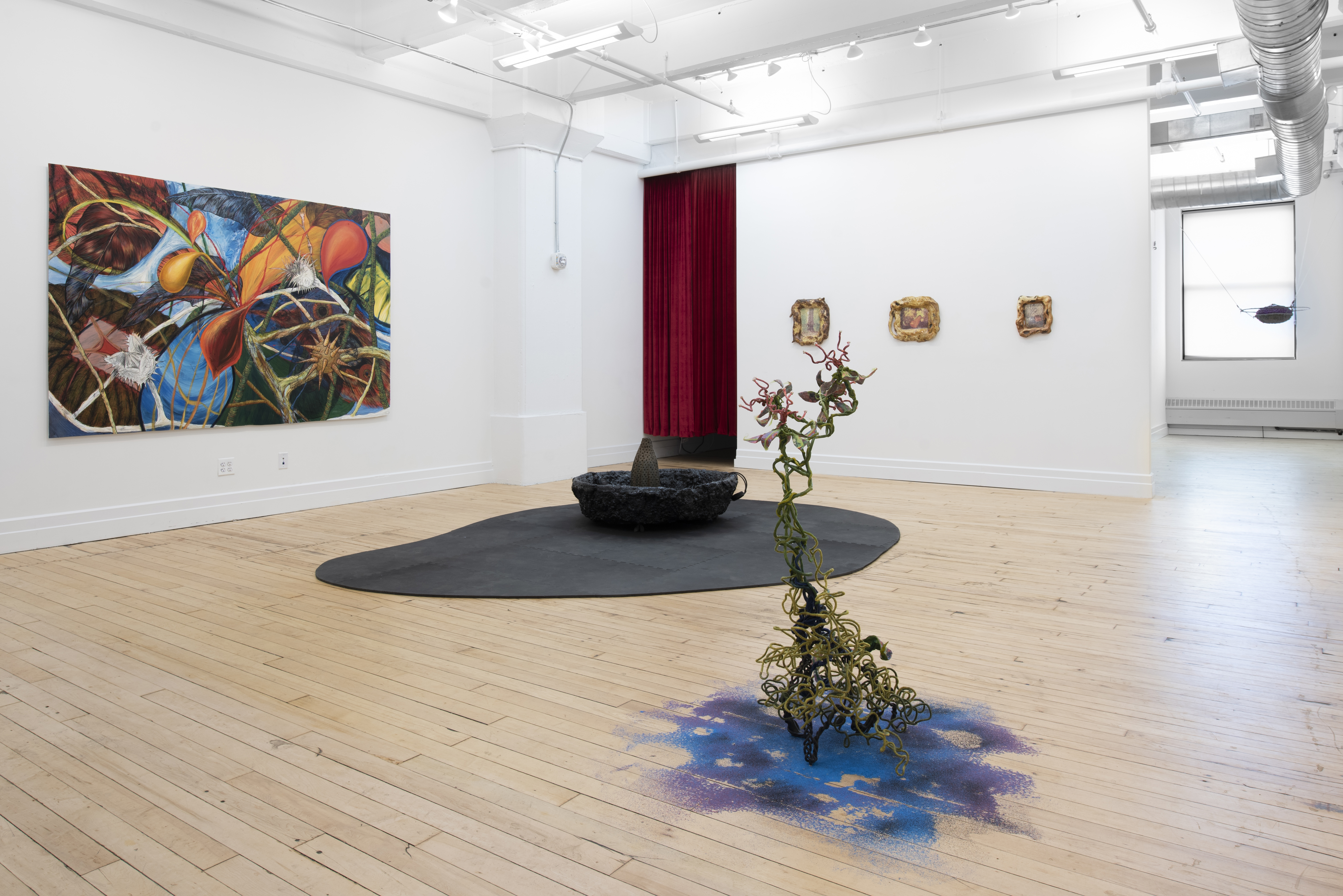
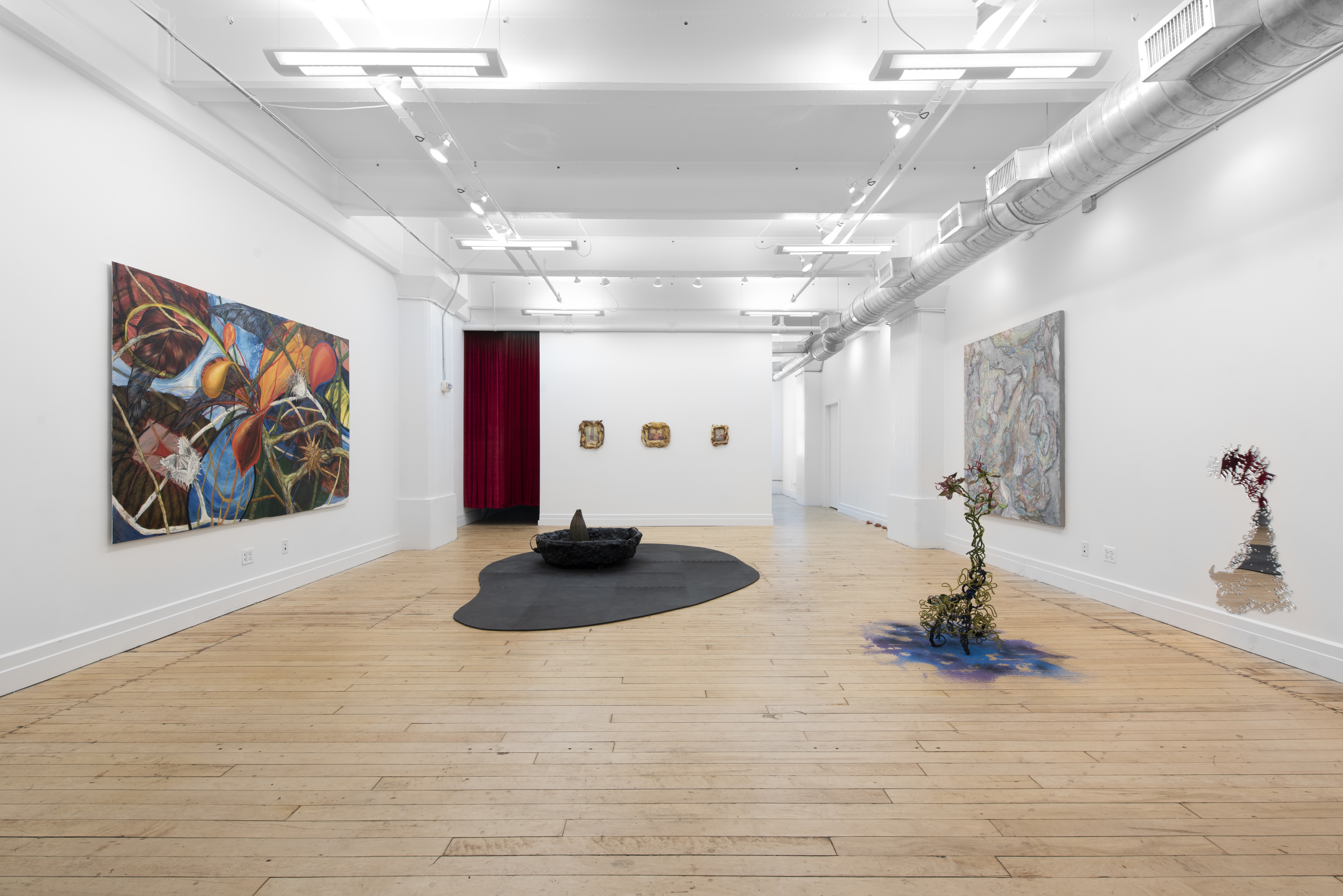
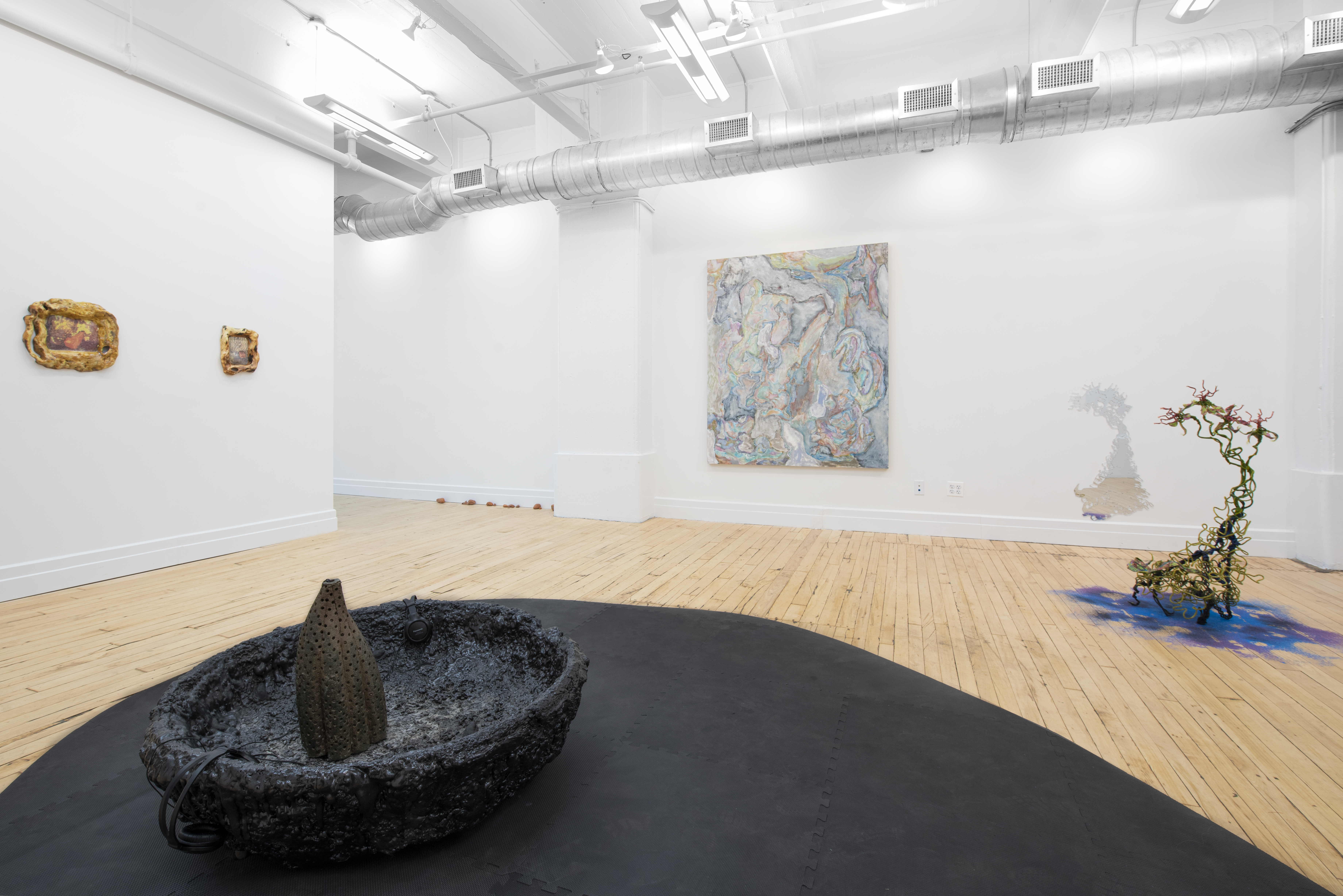
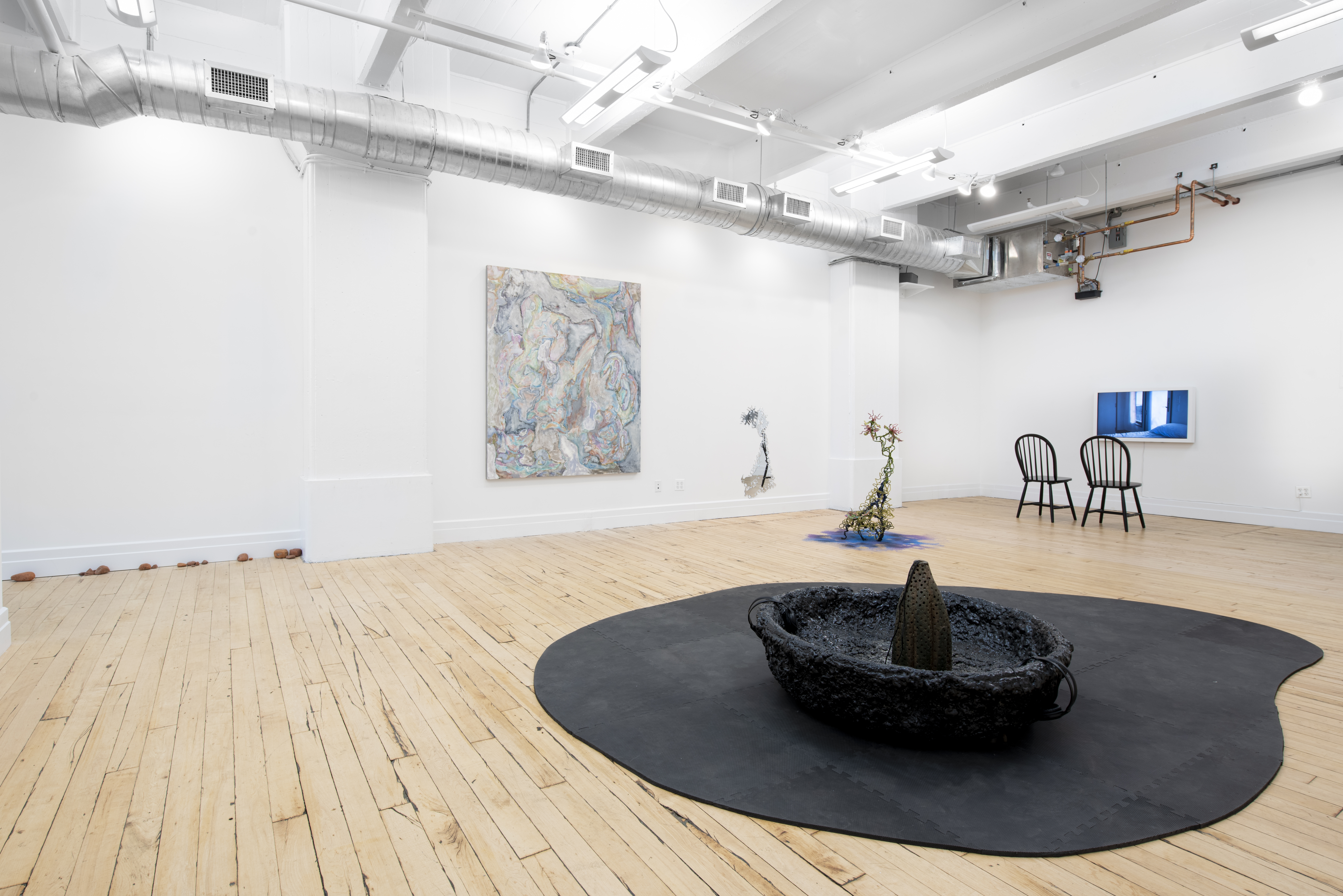
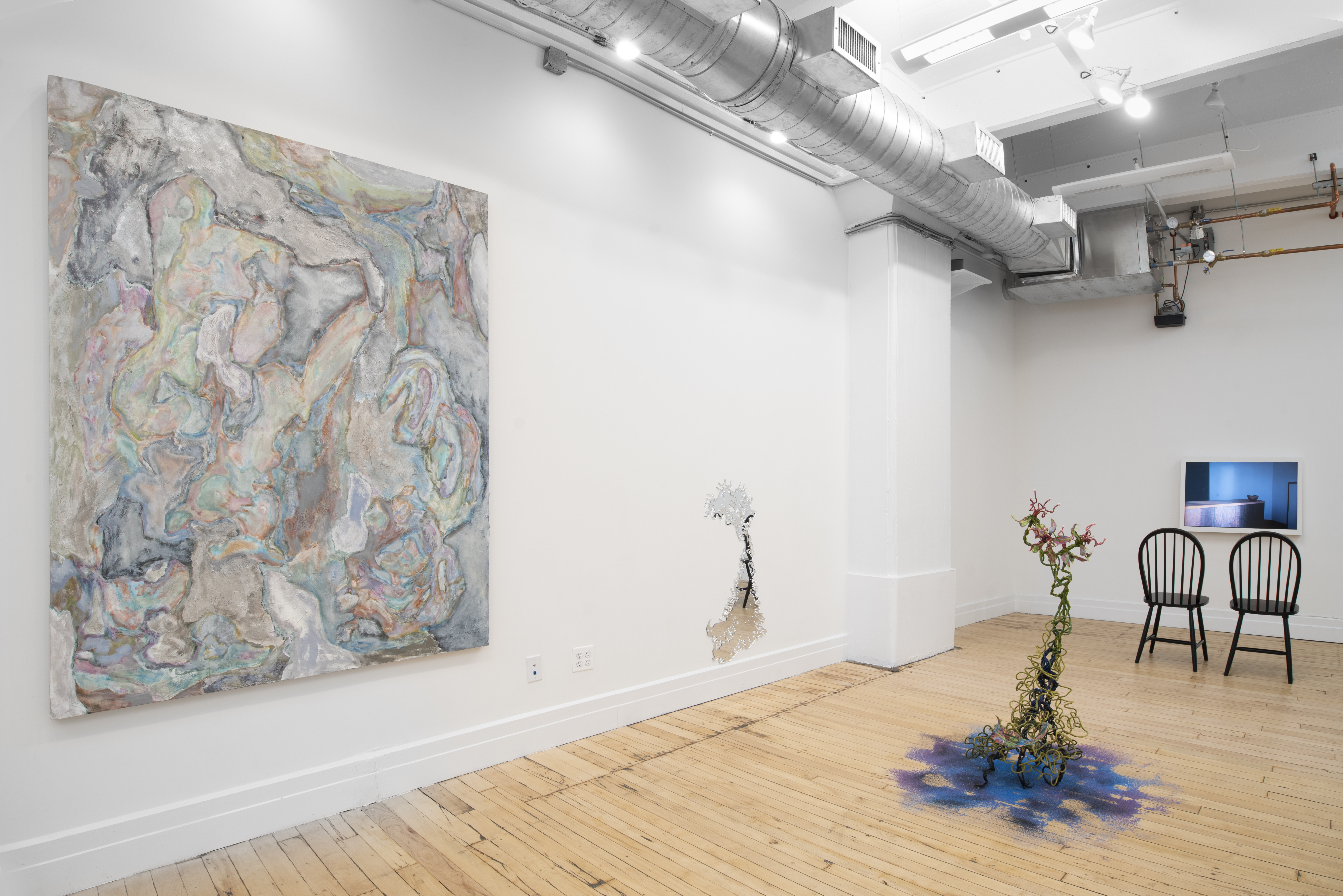
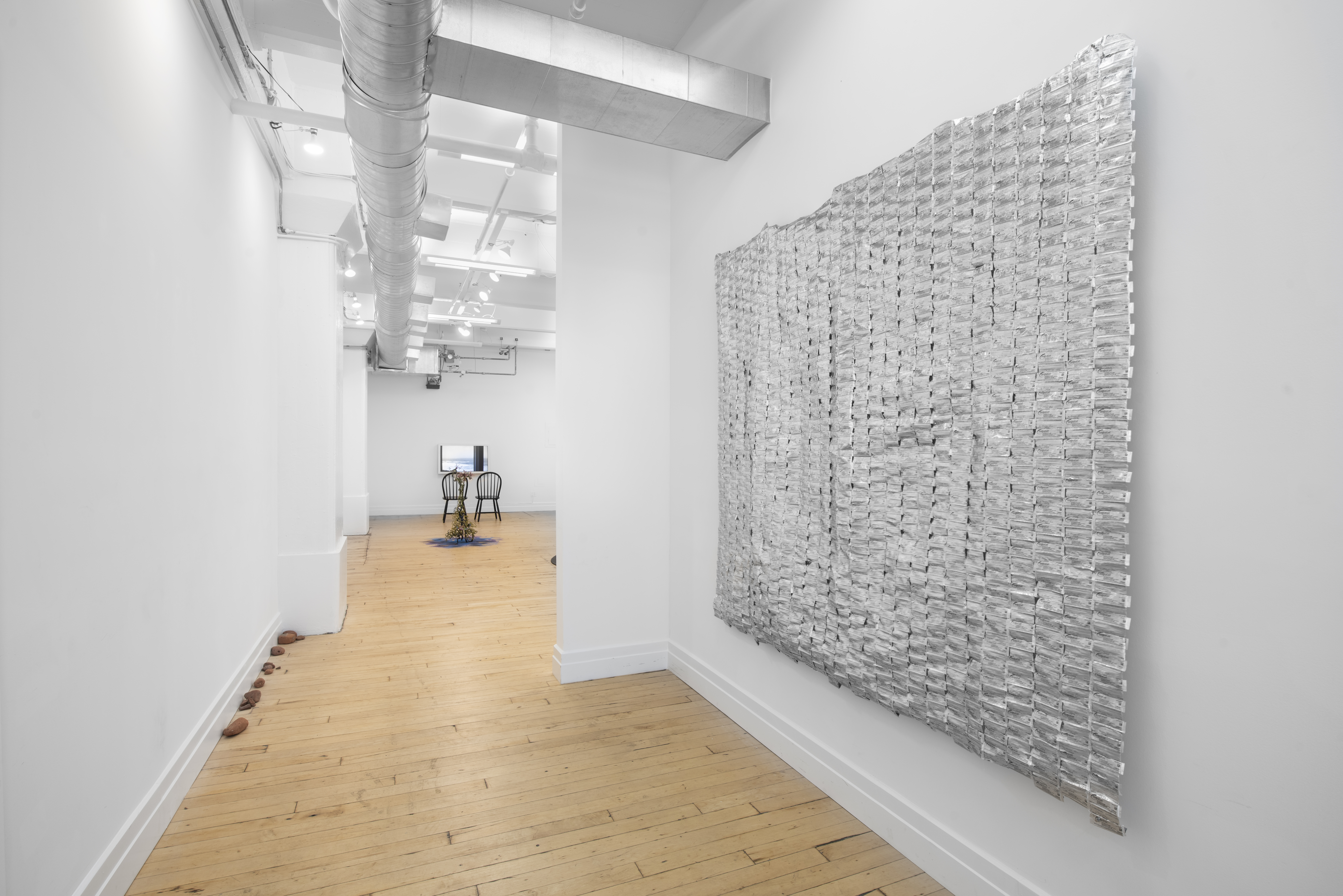
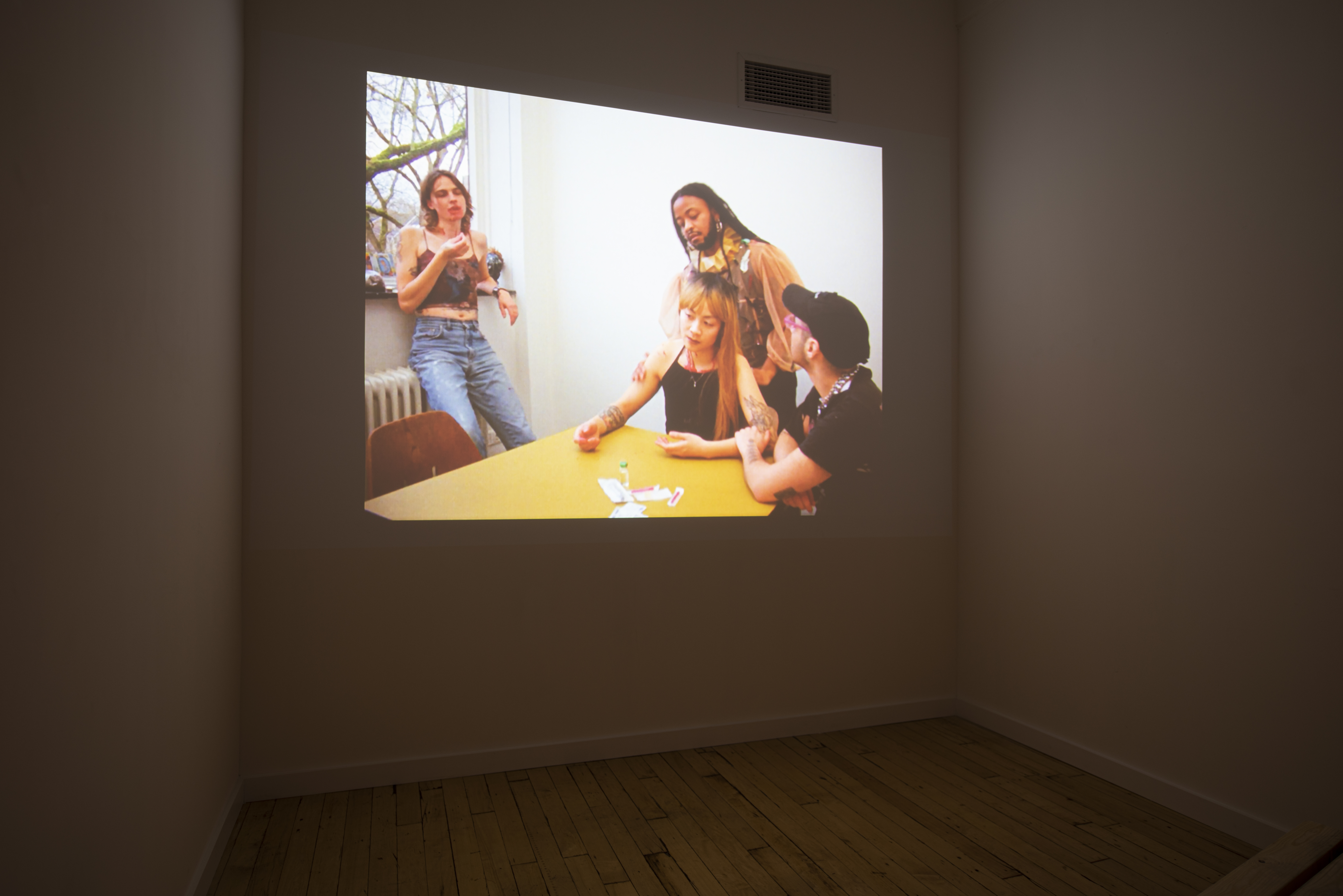
Sympathetic Lightning features work by 9 artists who variously expand understandings of ‘nature’ through themes of haunting, dislocation, and non-linear time. The term ‘sympathetic lightning’ refers to the tendency of lightning to be closely coordinated across long distances, appearing in clusters when viewed from space. Underlining solidarities both within the works and between the artists themselves, this exhibition highlights queer and trans perspectives in a political moment where mobility is especially fraught. Brought together by artist Sarah Davidson and curator Nirvana Santos-Kuilan, the exhibition includes the work of New York based artists Jacq Groves, Diana Sofia Lozano, Saar Shemesh, Erin Johnson, and Sarah Davidson, alongside international peers Laur P (Montréal, Canada), Jay Pahre (Vancouver, Canada), and mosquito girlfriend (Gabi Dao and Lou Lou Sainsbury, both Rotterdam, NL).
Set against a misty mountainscape, mosquito girlfriend (Gabi Dao and Lou Lou Sainsbury)’s eco-horror Resurrect Me as a Parasite plays on the nature of the vampire as a parasitic force. Interspliced images of Sint Pietersberg quarry in the Netherlands, and the Magdalene cave of Sainte-Baume Mountain in southern France–said to have been the site of Mary Magdalene’s exile and isolation–loom over the experimental narrative, conjuring cyclical ideas of life, death, gender and parasitism.
Jacq Groves’ series Embodied Infrastructures echoes ideas of cyclical entanglement, tracking time through movement as nature and object consume one another. Groves’ vignettes of trees molding themselves around architectural elements highlight the continuous nature of materials and the permeability of bodily boundaries.
Sarah Davidson’s layered compositions of plant and animal fragments also uncannily mesh worlds, troubling bodily boundaries through a mix of biomorphic abstraction and scientific illustration. The title of their painting, Crypsis–another word for camouflage–implies both the double edged sword of visibility and the queer potential of code-switching.
Saar Shemesh’s visceral sculptures THE LOST SALT and SATURN IN THE FOURTH HOUSE reference natural elements such as membranes and mucus, and integrate bodily substances like ‘communal piss’, to create wholly new forms. Oozing, dripping elements evoke monstrosity, otherness, and the abject body.
Boundaries are shown to be ever-shifting in Diana Sofia Lozano’s sprawling botanical hybrids. Embedding militarized maps in her work, the artist deconstructs boundaries of colonial identification, highlighting the fraught relationship of botany to geopolitical borders.
In Erin Johnson’s To be Sound is to Be Solid, tracking camera movement suggests a ghostly presence surveying the empty rooms of a seaside house. Voiceover of conversation with an oceanographer attempting to map the ever-shifting ocean floor parallels the filmmaker’s attempt to excavate the house’s uncharted queer history.
Jay Pahre’s ongoing Space Blanket is an intimate tracking of time and ritual, as daily testosterone gel packets are stitched together to form a space blanket, an object used for warmth and protection in the wilderness. The abstracted blanket infers the presence of the artist’s body while itself becoming a source of camouflage, reflecting its environment.
The reflective surface of Laur P’s Will our record misrecognize us too? echoes this strategy. Drawing parallels between fossilization and the act of painting, the artist highlights the trans-poetic potential of kinship across geologic time. In their writing about this work they ask “is it funny to imagine us fossilized, but safe?”
—
ERIN JOHNSON is a visual artist and filmmaker based in New York. Her immersive installations and short films explore notions of collectivity, dissent, and queer identity. In her shape-shifting videos, constellations of artists, biologists, and film extras address the imbrication of science and nationalism. Johnson was recently a current Working Artist Fellow at Pioneer Works (Brooklyn, NY) and a Winter Resident at Wave Hill (Bronx, NY).
Johnson received an MFA and Certificate in New Media from UC Berkeley in 2013, attended Skowhegan School of Painting & Sculpture in 2019, and has recently completed residencies at Jan van Eyck Academie (Maastricht, NL), Lower Manhattan Community Council (LMCC), Hidrante (San Juan, PR), and Lighthouse Works (Fishers Island, NY). Her work has been exhibited or screened at e-flux (Brooklyn), Rencontres Internationales de Paris/Berlin, BIENALSUR 2023 (Buenos Aires), MOCA Toronto (Toronto), Munchmuseet (Oslo), Sanatorium (Istanbul), Times Square Arts (New York), deCordova Sculpture Park and Museum (Boston), Billytown (The Hague), and REDCAT (LA). https://www.erinjohnson.online/
GABI DAO (they/them) is an artist based in Maastricht, The Netherlands and is from the unceded and ancestral territories of the xʷməθkwəy̓əm, Skwxwú7mesh and Səl̓ílwətaʔ/Selilwitulh Nations (Vancouver, Canada).
Dao’s practice culminates in collage, sculpture, sound and moving image installations with an insistence on multiple truths, blurry temporalities, sensory affirmations and ways of knowing otherwise. They work through long-gestating, fluid processes of gathering, breaking and repairing from their own world-making vernacular of audio/visual fragments, tactile collections of whatnots and scraps of linguistic detritus. Thinking with these materials, their work often begins within the slippages of ‘history’, archives and storytelling—towards channeling the ineffable tensions between grief and joy, alienation and belonging, dissidence and complicity, disassociation and sentimentality. From this juncture, Dao attempts to reclaim and re-enchant meaning-making from the ruins of capitalism and colonialism, especially in the ways they have extracted from racialized, gendered and more-than-human communities. In 2024, they started the collaborative project mosquito girlfriend with artist and filmmaker Lou Lou Sainsbury.
They have screened and exhibited their work at E-flux Screening Room (Brooklyn, USA), Southern Alberta Art Gallery Maansiksikaitsitapiitsinikssin (Lethbridge, CA), A Tale-of-a-Tub (Rotterdam, NL), The National Gallery of Canada (Ottawa, CA) and Vincom Centre for Contemporary Art (Hà Nội, VN). They were recently in residence at Triangle Astérides (Marseille, FR) and the EKWC (Oisterwijk, NL). They are currently in residence at Jan van Eyck Academy. https://www.gabidao.com/
LOU LOU SAINSBURY (b. 1994; London) is an artist based in Rotterdam & London, working across moving image, live-performance, poetry, drawing, sculpture and textiles. Sainsbury’s work seeks to tell stories exploring histories of resistance, transformation and entanglement. With collaboration at the core of her practice, rituals and invocations, collective study, domestic intervention, adaptation, songwriting and make-shift mutations make up some of her idiosyncratic research methods. Making connections between spirituality, medicalisation, colonialism and technology, her tricksterish work attempts to excavate a historical and imagined past of transfeminized and queer life within the brokenness of human and more-than-human worlds. In 2024, she started the collaborative project mosquito girlfriend with artist and filmmaker Gabi Dao.
Her recent solo exhibitions include Ehrlich Steinberg, Los Angeles (2024); Roodkapje, Rotterdam (2023); Gasworks, London & Humber Street Gallery, Hull (2022); and Well Projects, Margate (2020). She has presented in group exhibitions and festivals internationally including Rencontres Internationales (Paris & Berlin), Tate Modern (London), Chapter (Cardiff), Alchemy Film Festival (Hawick), International Film Festival Rotterdam, Nottingham Contemporary, La Casa Encendida and Yaby (Madrid). Sainsbury has been the recipient of numerous grants and awards, including Mondriaan Fonds (both 2023 & 2025) and Freelands Gasworks Partnership Programme (2021-2023). https://loulousainsbury.com/
DIANA SOFIA LOZANO (b. 1992, Cali, Colombia), is an artist based in Brooklyn, NY. Her work uses the language of botanical hybrids; the naturally occurring, genetically modified, and the imagined. Lozano presents biomimicry as metaphors for identity construction at the intersections of gender, sexuality, and the politics of difference. She is interested in the deconstruction of botanical taxonomic failures in order to reveal and redefine the boundaries of colonial identificatory practices and geopolitical borders. Lozano has exhibited at Company Gallery, Deli Gallery, Proxyco Gallery, Rachel Uffner Gallery, and and Wave Hill Gardens in NYC; Guerrero Gallery in San Francisco; New Image Art in Los Angeles; Casa Prado in Barranquilla, Colombia; Örebro Konsthall in Örebro, Sweden; Parallel in Oaxaca, Mexico; Arto Kyoto in Kyoto, Japan; and Capsule Gallery in Shanghai, China, among others. Lozano holds an MFA in sculpture from Yale University. https://www.dianaslozano.com/
LAUR P's pictorial and sculptural work offers a speculative visibility of paleo-ecological compositions in becoming, an imaginary space that they investigate from a queer-crip perspective. In their works, fragments of inter-species compositions compress through a slow process of accretion, decomposition and re-emergence. Throughout this stratigraphic process they seek fossilization and indetermination while paying particular attention to the agential force of the materials they use. This intuitive and taphonomic approach allows them to visualize entanglements that are at once underworldly and topographical, micro- and macroscopic, and in which various temporal and metaphorical dimensions intersect.
On the periphery of eco-critical considerations of contemporary nature-cultures and the hauntings they reveal, Laur P’s assemblages of pictorial fossils invite a rapprochement between the formal contemplation of materials that are associated in their work and their intertwined intentions, which are, to disrupt speciesist understandings of evolution and natural phenomena, to disturb the tradition of the landscape as a space for humanistic representation of nature, to disorient ableist pictorial conventions, and therefore to resist anthropocentric myopia.
Laur P is a trans non-binary neuroqueer based in Tiohtià:ke-Mooniyang-Montréal. They hold an MFA from the University of Guelph (2021) and a BFA from Concordia University with Great Distinction (2015). Throughout their academic background, they received several awards including the Joseph-Armand-Bombardier Canada Graduate Scholarship (SSHRC, University of Guelph) and the Betty Goodwin Prize in Studio Arts (Concordia University), and their current program of work is supported by the Canada Council for the Arts. Their most recent solo exhibitions include A Scape Unnamed (Galerie Nicolas Robert, 2021), More-than-ghosts (Virtual thesis exhibition, 2021) and It Once Was a Garden (Galerie McClure, 2018). Laur P's work is part of the collections of the Art Gallery of Ontario, Hydro-Québec, Royal Bank of Canada and Scotiabank, among others. https://www.laur-p.com/
JACQ GROVES is an interdisciplinary artist, researcher, and educator based in Queens, New York. Their project-based practice explores relationships between urban and natural ecological structures and complex bodily systems. They were the 2024 recipient of a Queens Arts Fund grant awarded by NYFA to develop a new project Embodied Infrastructure. Supporting this new work, Jacq will be an artist-in-resident at Loghaven Artist Residency and Stove Works’ Artist Residency. Previously, they exhibited a solo, site-specific show for Wave Hill’s Sunroom Project Space in the Bronx. Their work has been included in NYC-based exhibitions at Essex Flowers, The Jewish Museum, The Wallach Art Gallery, the NARS Foundation, Chashama, Half Gallery, and more. Groves’ work has also been included in group exhibitions at Ogden Museum of Southern Art (New Orleans, LA), Yale University's Edgewood Gallery (New Haven, CT), White Page Gallery (Minneapolis, MN), Women's Studio Workshop (Rosendale, NY), and others. They've also been an artist-in-resident at Vermont Studio Center (Johnson, VT) and the NARS Foundation (Brooklyn, NY). Currently, Groves is completing a research and teaching fellowship as the Foundations Fellow in Arts + Sciences at Pratt Institute. In 2022, they received their MFA in Visual Art from Columbia University. https://www.jacqgroves.com/
JAY PAHRE is a queer and trans settler artist, writer, and cultural worker currently based on the unceded territories of the xʷməθkʷəy̓əm, Sḵwx̱wú7mesh, and səlilwətaɬ peoples. His work engages trans and queer ecologies, interspecies collaboration, and place in the context of settler colonialism. The use of metal, electricity, and heat has been instrumental in his work to think through conductive and transforming ecologies. Leaning on these moments of conductivity and transformation, his work seeks to ferret out alternative formations and futures of what queer and trans ecologies of being might look like while slipping through moments of temporal, embodied, and environmental precarity.
He has attended residencies at the Western Front, Banff Centre, and Isle Royale National Park. His work has been exhibited across the US and Canada at traditional galleries and community spaces, and his writing has been published in academic journals and comic anthologies. He was selected for the 2020 Transgender Studies Chair Fellowship at the University of Victoria, as well as the Helen Belkin Memorial Scholarship (2020) and Fred Herzog Award in Visual Art (2019) at the University of British Columbia. https://www.julianpahre.com/
SAAR SHEMESH (b. 1991, New York) is an artist and educator whose creative practice uses the aesthetics of feminist abstraction and abjection to complicate bodily, spatial, and emotional binary logics through architectural interventions/ installations, sculptures, and text/ image-based studies. Through the use of materials like metal, silicone, foam, and wax that undergo a state change in order to take shape, they call upon visual references like mucosal membranes and craters to evoke visceral or destabilized feelings in viewers.
Shemesh has been an artist-in-residence at the NYPL Picture Collection (New York), Visual Arts Center (Richmond), RAIR (Philadelphia), Franconia Sculpture Park (Shafer), and SOMA (Mexico City). Most recently, their work has been exhibited at D.D.D.D. (New York), Current Space (Baltimore), Vox Populi (Philadelphia), Artlot (Brooklyn), and Virginia MoCA (Virginia Beach). They hold an MFA in Sculpture and Extended Media from Virginia Commonwealth University and a BFA from Cooper Union for the Advancement of Science and Art. https://www.saarshemesh.com/
MARS DIETZ has an extensive career history working as a solo sound artist, club DJ, musician and sound designer in the choreographic and performing arts community in Berlin, with commissions and performances at the Spinnerei Leipzig, Sophiensaele Berlin, Haus der Kunst Munich, PopKultur Festival Berlin, Creamcake Berlin's 3hd Festival, Kunsthaus KuLe, e-werk Luckenwalde, Ballhaus Ost, as well as the Portland Institute for Contemporary Art, the Institute for Electronic Arts, ABC No Rio, Brooklyn College, and further locations in the United States. Mars' work has been supported by the Hauptstadtkulturfonds, Berliner Senatsverwaltung für Kultur und Europa, Musikfonds e.V., Alfred University, Creamcake Berlin, Amplify Berlin, and most recently Makerspace NYC. Mars performed as a resident DJ and collective member of BODYSNATCH, a monthly underground club night in Berlin focused on bass-forward music that sustained a dedicated cult following from 2011 - 2022. https://marsdietz.xyz/
SARAH DAVIDSON (b.1989, Canada) works primarily between drawing and painting to create compositions in which shadowy, biomorphic figures and delicate, foliated fragments mingle. Making reference to a history of discourses constructing the ‘natural’ world, their works investigate bodies, environment, observation, and the tangled strings which often bind them together. While often drawn directly from ‘nature’, their drawings diffract distinctions between embodied self and other through a queer ecological lens: critters and space collapse into one another, suggesting a permeable web. Both the eye and the mind work towards the known--animals, plants, brush marks, lines--but are caught in a space of undoing. A question floats among the forms: who’s seeing who, and how?
Davidson is originally from Canada, where they pursued their art education, at Emily Carr University (BFA, Visual Art, 2015) and the University of Guelph (MFA, Visual Art, 2019). From 2011-2021, they worked as a hiking and climbing guide, spending months of each year in remote locations in Canada, the United States and Scandinavia. In 2022, they relocated to New York. They have exhibited their work throughout Canada and the United States, including solo exhibitions at Auxier Kline, New York (2025), Shin Gallery, New York (2024), NARS Foundation, Brooklyn (2023), Wil Aballe Art Projects, Vancouver (2022), Feuilleton, Los Angeles (2021), and Erin Stump Projects, Toronto (2019). Their work has been covered by ArtNEWS, Mousse Magazine, Canadian Art, Fukt Magazine, and more. https://sarahdavidson.ca/
NIRVANA SANTOS-KUILAN is a Brooklyn-based arts programmer and curator. She is currently the Manager of Public Programs at the Museum of Arts and Design. Previously, she has held positions at the Leslie-Lohman Museum of Art and NARS Foundation. https://nirvanasantos.com/